
What Is a Bridge Plug Setting Tool For?
The core mission of a bridge plug is to temporarily or permanently isolate a well interval inside the casing or tubing — separating the formations above and below to create conditions for staged fracturing, channel-leak control and plugging, and well abandonment. Whether a plug “sets securely and seals reliably” often depends less on the plug itself than on the setting tool that runs with it.
The setting tool does two jobs: first, it safely delivers the bridge plug to the designed depth; second, it applies a setting force so the plug completes two actions — “anchoring + sealing” — then releases from the plug and is pulled out of the hole. In short, the setting tool is the final push that turns a bridge plug from a run-in tool into an in-well barrier.
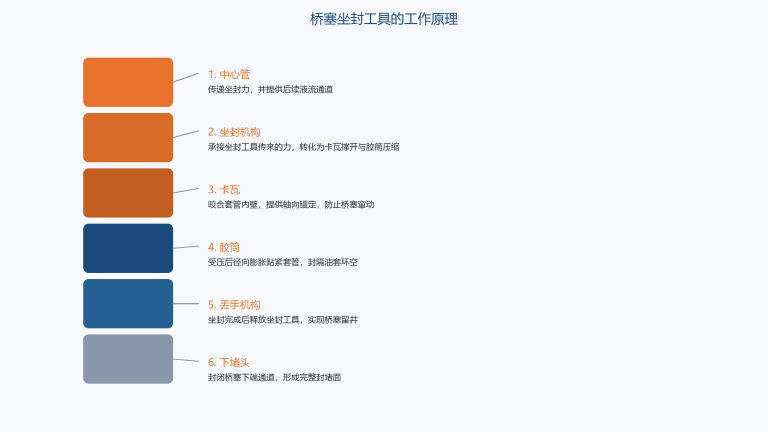
Structure of the Bridge Plug Body
- Center tube — transfers the setting force and provides a subsequent flow passage.
- Setting mechanism — takes the force from the setting tool and converts it into slip expansion and packing-element compression.
- Slips — bite into the casing wall to provide axial anchoring and prevent the plug from moving.
- Packing element — expands radially under compression to press against the casing and seal the annulus.
- Release mechanism — releases the setting tool after setting, leaving the plug in the well.
- Bottom plug — closes the lower passage of the plug to form a complete seal.
How the Three Types of Setting Tools Work
Mechanical setting tool: relies on the pipe string’s own weight, or on rotation/pressing during run-in or pull-out, to transmit mechanical force through the center tube to the setting mechanism, expanding the slips and compressing the packing element. Simple in structure, no hydraulic equipment required; suitable for conventional workover and staged operations.
Hydraulic setting tool: pressure is applied from surface down the tubing or drill pipe; hydraulic pressure drives the piston upward, converting the setting force into slip expansion and packing-element compression. One tool size can fit a range of casing sizes, and the setting load is easy to control precisely.
Wireline (electric-line) setting tool: the bridge plug is conveyed directly to the target depth by cable from surface, with no need to run or pull a pipe string; once in place it is set hydraulically and released. Especially suited to wells that are already perforated or where running pipe is not advisable — more efficient, used mainly abroad.
Five Steps of a Complete Setting Operation
- Run in — the setting tool and bridge plug are made up and conveyed with the pipe string or cable to the designed depth.
- Depth correlation — the setting depth is verified against well-log curves or pipe-string data to avoid interval error.
- Set — mechanical or hydraulic force is applied and the setting mechanism starts to act.
- Anchor and seal — the slips bite into the casing wall and the packing element compresses to form a seal.
- Release — the setting tool is released and pulled out of the hole; the plug stays in place to complete the isolation.
Four Control Points for Setting Quality
- The slips must bite into the casing wall to a certain depth for reliable anchoring; in deformed or collapsed casing, the well should be drifted and scraped beforehand.
- The packing element must be compressed sufficiently; a one-piece element provides more uniform sealing than a segmented one.
- The setting load must be held to avoid premature pressure bleed-off that leaves the plug incompletely set.
- A one-piece slip design helps avoid obstruction mid-run and improves run-in success.
How to Choose a Setting Tool
- Conventional workover and staged operations: mechanical setting — economical and reliable.
- Multiple casing sizes and precise pressure control needed: hydraulic setting.
- Already perforated, or pipe running not advisable: wireline setting.
- If the plug will later be milled out: choose a drillable bridge plug with the matching setting tool; for long-term isolation: choose a permanent bridge plug.
Puyang Kerui Mechanical Engineering Technology Co., Ltd. supplies bridge plugs and matching selection plus field technical service for mechanical, hydraulic and wireline setting tools. If the on-site well conditions are special (deformed casing, high H2S, highly deviated wells, etc.), a standard model may not fit. Kerui has years of experience in custom downhole tools and can provide a targeted solution based on the actual wellbore geometry and operational requirements.